Emotional Intelligence Coaching for Better Self-Awareness and Communication
Emotional intelligence coaching is a structured way to help people notice emotional patterns, communicate with more care, and turn feedback into practical behavior change. It is especially useful for leaders, managers, coaches, students, and professionals who already know that emotional intelligence matters but need a clearer way to practice it. A coach does not simply label someone as "high EQ" or "low EQ." The better goal is to build self-awareness, self-regulation, empathy, motivation, and social skill in real situations. For a grounded starting point, an online EQ self-reflection tool can help you notice which areas may deserve more attention before you plan deeper coaching work.

What Emotional Intelligence Coaching Actually Means
At its best, emotional intelligence coaching is a development process, not a personality verdict. It helps a person observe what happens before, during, and after emotionally charged moments. A client might review how they respond to criticism, how they listen when someone disagrees, how they handle stress before a presentation, or how they repair trust after a tense meeting. The coach then helps convert those observations into repeatable actions.
The work often draws from familiar emotional intelligence models. Daniel Goleman's five-domain model is especially common: self-awareness, self-regulation, motivation, empathy, and social skill. Some training programs use four categories, such as self-awareness, self-management, social awareness, and relationship management. The language differs, but the central idea is similar. People perform better when they can understand their own emotions, respond instead of react, read the emotional context around them, and build stronger relationships.
That is why emotional intelligence in coaching and mentoring can be so practical. The topic sounds abstract, yet the coaching conversation usually lands in ordinary moments: pausing before sending a sharp email, asking a better follow-up question, naming frustration without blaming someone, or noticing when a direct report has gone quiet.
What an Emotional Intelligence Coach Helps With
An emotional intelligence coach helps clients turn self-observation into new behavior. The coach may help someone identify triggers, reflect on values, practice language for difficult conversations, or build a plan for asking for feedback. The coach may also help a client notice patterns that are hard to see alone, such as interrupting under pressure, avoiding conflict, over-apologizing, or reading neutral feedback as personal rejection.
This does not mean the coach provides therapy, clinical assessment, or certainty about a person's inner life. Coaching is most appropriate when the focus is growth, performance, communication, leadership, or daily behavior. If a person is dealing with severe distress, safety concerns, trauma symptoms, or ongoing mental health needs, a qualified professional is the better support.
A useful coaching engagement usually includes four parts:
- A baseline reflection on strengths, patterns, and current friction points.
- A goal that is behavioral enough to practice, such as "respond calmly to corrective feedback."
- A small set of exercises, scripts, or reflection routines.
- A review rhythm so the client can track what changed and what still feels difficult.
For people who want a lighter starting point before hiring a coach, an emotional intelligence assessment guide can make the first conversation more specific by showing which domains feel strongest or most uneven.
Core Skills Coaches Often Develop
Emotional intelligence coaching usually begins with self-awareness because people cannot adjust a pattern they cannot see. In a coaching session, this may look like slowing down a recent interaction and asking: What did you feel first? What did you assume? What did you do next? What did the other person seem to need from you?
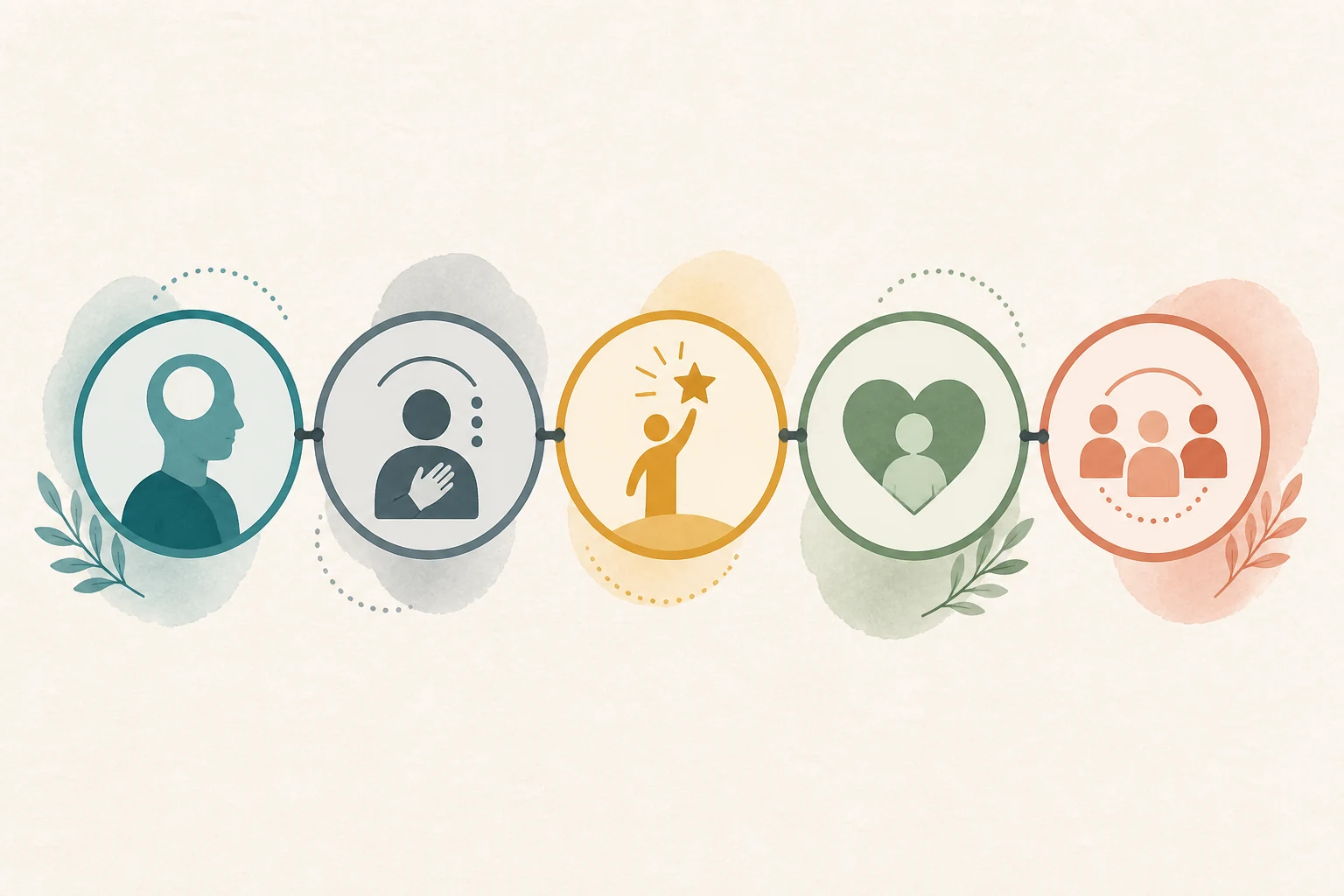
Self-regulation comes next. This skill is not about suppressing emotion. It is about creating enough space to choose a response. A client might practice a pause, a breathing routine, or a short phrase such as "I want to think about that before I respond." In leadership, this can prevent a rushed reaction from becoming a team-wide problem.
Empathy and social awareness help the client look beyond their own internal weather. Coaches may encourage perspective-taking, active listening, and better attention to tone, timing, and nonverbal cues. In real work, this might mean noticing that a team member is agreeing too quickly, that a client is confused but polite, or that a colleague needs clarity before reassurance.
Social skill turns insight into behavior. This includes asking direct but kind questions, repairing misunderstandings, giving feedback without shaming, and negotiating needs without turning every disagreement into a contest. Emotional intelligence coaching becomes valuable when these skills move from good intentions into observable habits.
How a Coaching Process Might Work
A practical emotional intelligence coaching process rarely depends on one dramatic insight. It usually works through small cycles of observation, practice, feedback, and adjustment.
First, the client defines a real situation. "I want to handle feedback better" is a start, but "I want to stay curious when my manager challenges my draft" is easier to practice. Second, the coach helps the client notice the emotional pattern. Does the person feel embarrassment, irritation, fear, shame, confusion, or defensiveness? What story do they tell themselves in that moment?
Third, the client chooses one replacement behavior. This could be asking one clarifying question before defending a decision, repeating back what they heard before responding, or taking five minutes to write down the emotion and need behind a reaction. Fourth, the client tests the behavior in real life and reviews the result with the coach.
The review matters because emotional intelligence learning is often subtle. A client may not suddenly become calm in every hard conversation. But they may recover faster, listen longer, avoid one unnecessary escalation, or repair a conversation sooner. Those small shifts are meaningful because they are repeatable.
Coaching for Leaders, Teams, and Everyday Relationships
Executive coaching and emotional intelligence often overlap because leadership is full of emotional data. A manager has to read the room, hold tension, admit mistakes, give feedback, motivate different people, and make decisions when pressure is high. Technical skill may earn trust at first, but emotional skill often determines whether people keep sharing honest information.

For teams, coaching can support shared language. Instead of saying, "People here communicate badly," a group can name specific patterns: we avoid hard topics, we interrupt when stressed, we mistake speed for clarity, or we give feedback too late. From there, the team can practice meeting norms, listening routines, and repair steps.
Everyday relationships benefit too. Emotional intelligence coaching can help someone pause before reacting to a partner, ask a friend a more patient question, or recognize when they are using sarcasm to avoid vulnerability. The point is not to become perfectly composed. The point is to become more aware, more responsible, and easier to communicate with.
Certification, Career Questions, and Choosing Support
Searches around emotional intelligence coach certification, certification online, salary, and jobs show that many people are not only curious about receiving coaching. They are also considering whether to become an emotional intelligence coach. That path requires careful evaluation.
Certification can be useful when it provides a credible framework, supervised practice, ethical boundaries, feedback on coaching skills, and clear rules about scope. It is less useful when it is only a badge with little practice. If you are comparing programs, look for transparent curriculum, instructor qualifications, practice hours, assessment tools, and whether the program fits your audience. Some coaches may also consider broader coaching credentials, such as ICF-aligned training, depending on their professional goals.
Salary questions are harder to answer because income depends on niche, experience, location, client type, business model, and whether coaching is a full-time practice or part of another role in HR, leadership development, education, or consulting. Treat salary estimates as rough market signals rather than promises.
If you are choosing support for yourself, prioritize fit over hype. A good coach should explain their process, respect boundaries, welcome questions, and avoid claims that sound too absolute. Ask how they handle confidentiality, what kinds of goals they support, and when they refer someone to another professional.
Simple Exercises Used in EQ Coaching
The most useful exercises are simple enough to repeat during a normal week. Try these as reflection prompts, not as a substitute for individualized support.
-
Trigger review: After a tense moment, write the situation, the feeling, the assumption, the action, and the result. Look for patterns across several entries.
-
Pause script: Choose one sentence you can use when emotions rise, such as "I want to respond thoughtfully, so give me a moment."
-
Listening ratio: In one conversation, aim to ask two genuine questions before offering your view. Notice whether the other person shares more useful information.
-
Repair practice: When a conversation goes poorly, name the impact without overexplaining. For example: "I spoke too sharply earlier. I want to reset and hear your concern."
-
Strength reflection: Identify one EQ skill you already use well. Then ask how you can use that strength without overusing it. Empathy, for example, can become avoidance if it prevents honest feedback.

Turn Emotional Intelligence Coaching Into Everyday Practice
The real test of emotional intelligence coaching is not how insightful a session feels. It is whether the client can behave a little differently when life becomes inconvenient. Can they stay present when feedback stings? Can they hear frustration without rushing to defend? Can they name a need before resentment builds? Can they ask for repair before distance hardens?
Those questions are practical, human, and learnable. Emotional intelligence coaching gives them structure. It helps people turn emotional moments into data, then turn data into better choices. If you want a simple way to begin that reflection, you can explore an EQ growth starting point and use the results as a conversation starter for journaling, coaching, mentoring, or leadership development.
FAQ
What is emotional intelligence coaching?
Emotional intelligence coaching is a guided development process that helps people understand emotional patterns and practice better responses. It may focus on self-awareness, self-regulation, empathy, motivation, social awareness, communication, and relationship management.
What are the 5 C's of emotional intelligence?
The phrasing "5 C's" is not the standard version of the Goleman model. Many EQ articles instead discuss five components: self-awareness, self-regulation, motivation, empathy, and social skill. Some coaches translate these into memorable labels, but it is best to check what a specific program means by the term.
How is EQ coaching different from emotional intelligence training?
Training often teaches a group a shared framework or set of skills. Coaching is usually more personal and applied. It helps an individual connect the framework to specific behaviors, conversations, goals, and feedback patterns.
Do you need certification to become an emotional intelligence coach?
Requirements vary by country, employer, and coaching niche. A strong certification can help if it includes ethical boundaries, supervised practice, coaching skills, and a clear model. It should not be treated as a shortcut around real experience or professional responsibility.
Is ICF certification worth it for EQ coaching?
It can be worth considering if you want a broad coaching credential that clients or organizations recognize. Whether it is necessary depends on your niche, budget, prior experience, and whether you plan to coach independently, inside an organization, or as part of leadership development work.
How much do emotional intelligence coaches make?
Income varies widely. A coach's earnings may depend on location, audience, specialization, credentials, reputation, pricing model, and whether coaching is full time or part of a wider consulting, HR, training, or leadership role.
Can emotional intelligence coaching improve relationships?
It can support better relationship habits when the person practices consistently. Common areas include listening, naming emotions, regulating reactions, repairing conflict, and communicating needs more clearly. Results depend on the situation, effort, and support system around the person.