Emotional Intelligence Test for Leaders: Test-Driven Leadership Development
In today's competitive business world, what truly separates good leaders from great ones? It's not just about technical skills or a high IQ. The hidden cost of low emotional intelligence in leadership can be staggering. It leads to poor communication, disengaged employees, and missed opportunities. For HR professionals and leadership coaches, developing emotionally intelligent leaders isn't just a nice-to-have; it's a measurable and essential strategy for organizational success.
Are you equipped to identify and nurture the next generation of leaders in your company? Many organizations struggle to turn abstract leadership qualities into concrete development plans. This is where objective data becomes crucial. Our platform provides a clear, actionable way to measure and improve these vital skills. By using an effective emotional intelligence test, you can gain the objective metrics needed to cultivate the EQ skills that define exceptional leadership.

Why Emotional Intelligence Matters in Leadership
For decades, leadership potential was often linked to experience, industry knowledge, and cognitive intelligence (IQ). While these factors are important, modern leadership demands more. Emotional intelligence (EQ) has emerged as a critical differentiator. It is the ability to understand and manage your own emotions and to recognize and influence the emotions of those around you. In a leadership context, this translates into more effective, resilient, and inspiring management.
Beyond Traditional Intelligence: The EQ Advantage in Modern Leadership
Unlike IQ, which is relatively stable, EQ is a flexible set of skills that can be learned and improved. This is the advantage of EQ in leadership. A leader with high EQ can:
- Build Stronger Relationships: They connect with their team on a human level, fostering loyalty and collaboration.
- Communicate Effectively: They understand the unspoken cues in a conversation and can tailor their message for maximum impact.
- Manage Stress and Pressure: They remain calm and decisive during crises, providing a steady hand for their team.
- Inspire and Motivate: They empathize with their team's motivations and challenges, creating a positive and productive work environment.
Research-Backed Benefits of High-EQ Leadership Teams
The link between high EQ and leadership success is not just anecdotal; it is supported by extensive research. Studies from respected figures like Daniel Goleman have shown that emotional intelligence is a powerful predictor of performance, especially in leadership roles.
Organizations that prioritize and invest in leadership EQ assessment and development often see tangible benefits, including:
- Higher Employee Engagement: Leaders who are empathetic and supportive create environments where employees feel valued and motivated.
- Improved Team Performance: Teams led by high-EQ individuals collaborate more effectively and are better at problem-solving.
- Lower Employee Turnover: When leaders build strong, trusting relationships, employees are more likely to stay with the company long-term.
- Increased Profitability: All of these factors—engagement, performance, and retention—contribute directly to the bottom line.
When you invest in EQ, you're building a stronger, more resilient organization that starts at the top.
How Our EQ Test Identifies Leadership Potential
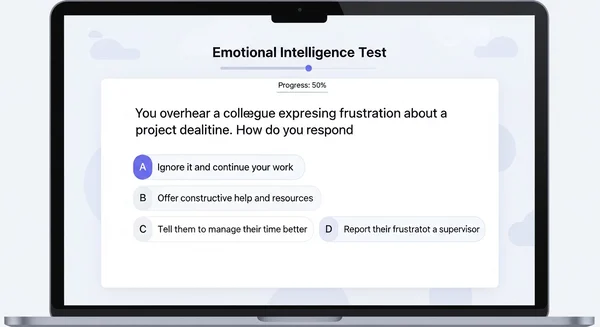
To develop emotionally intelligent leaders, you first need a reliable way to measure their current skills. A generic personality quiz won't provide the specific, actionable insights required for targeted leadership development. Our EQ test for leaders is designed to provide exactly that. It moves beyond simple scores to offer a nuanced view of an individual's emotional competencies.
The test is inspired by established scientific frameworks, ensuring that the questions are relevant and practical. By answering a series of situational and self-assessment questions, leaders can get a clear picture of their emotional landscape. For HR managers and coaches, this provides an invaluable starting point for effective training and development programs. Why not start your assessment now to see how it works?
Key Leadership EQ Dimensions Measured
Our assessment focuses on the core components of emotional intelligence that are most critical for effective leadership. These dimensions provide a comprehensive framework for understanding a leader's strengths and areas for growth:
- Self-Awareness: The ability to recognize and understand your own emotions, strengths, and weaknesses. A self-aware leader knows how their feelings affect their decisions and their team.
- Self-Management: The capacity to control impulsive feelings and behaviors, manage emotions in healthy ways, and adapt to changing circumstances.
- Social Awareness (Empathy): The skill of understanding the emotions, needs, and concerns of other people. Empathetic leaders can build trust and rapport with their teams.
- Relationship Management: The ability to develop and maintain good relationships, communicate clearly, inspire and influence others, and manage conflict.
By evaluating these key areas, our test helps you identify individuals with high leadership potential, even if they aren't in a formal leadership role yet. This makes it an essential tool for talent spotting.
Sample Leadership EQ Assessment Breakdown
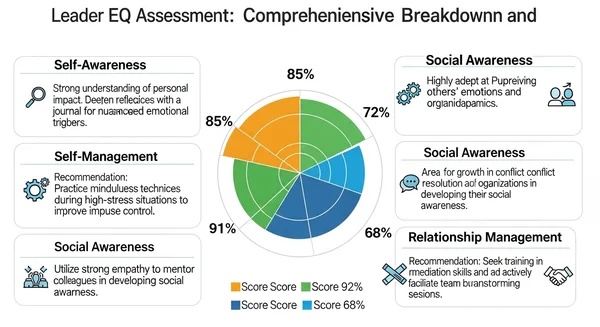
After completing the 20-question test, users receive an immediate baseline score. However, the real value for leadership development lies in the optional AI-driven deep-dive report. This personalized analysis doesn't just give you a number; it provides context.
For example, a report might show that a manager scores highly in Self-Management but has room for growth in Social Awareness. The breakdown would explain what this means in practice: this leader is likely excellent under pressure but may struggle to notice when their team is feeling overwhelmed or demotivated. The report then offers specific, actionable strategies, such as practicing active listening in one-on-one meetings or seeking feedback on their communication style. This transforms a simple test score into a personalized leadership development roadmap.
From Assessment to Development: EQ-Based Leadership Strategies
An emotional intelligence leadership development plan is only as good as its implementation. The assessment is the first step—the diagnosis. The next crucial phase is turning those insights into tangible behavioral change. This is where a test-driven approach shines, as it allows for highly targeted and effective development strategies.
Customizing Development Plans Based on EQ Strengths and Gaps
One-size-fits-all leadership training rarely works. A leader who needs to improve their empathy requires a different approach than one who needs to work on their stress management. Our assessment results enable you to create customized development plans that address each leader's unique profile.
- For a leader with low Self-Awareness: The plan might include journaling exercises, mindfulness practices, and seeking regular feedback from trusted colleagues.
- For a leader with low Relationship Management: Development could focus on communication workshops, conflict resolution training, and mentorship opportunities.
Focusing on specific EQ gaps ensures your training budget and efforts deliver maximum impact. This targeted approach accelerates growth and demonstrates a clear return on investment. Ready to build a better leadership team? Try our free tool to get started.
Case Study: How One Company Improved Leadership Performance Through EQ Development
Let’s consider a common scenario. A mid-sized tech company was experiencing high turnover within its engineering department. The department head was brilliant technically but was perceived as abrasive and unapproachable. The HR team decided to implement an EQ development program, starting with our assessment.
The test results confirmed their suspicions: the manager had exceptional analytical skills but scored low on Social Awareness and Relationship Management. Armed with this data, the coach worked with the manager on specific skills. They practiced reading non-verbal cues in meetings and rephrasing critical feedback to be more constructive.
Within six months, the change was noticeable. Team morale improved, communication became more open, and employee turnover in the department dropped by 30%. The manager not only became a more effective leader but also reported higher job satisfaction. This case illustrates how a data-driven approach to EQ development can produce real, measurable business outcomes.
The ROI of Emotionally Intelligent Leadership
Investing in emotional intelligence is not a soft skill initiative; it's a strategic business decision with a clear return on investment. Leaders with high EQ create more stable, motivated, and productive teams. They excel as negotiators, communicate with inspiration, and demonstrate remarkable resilience when facing challenges. By identifying and developing these skills within your organization, you are building a foundation for sustainable success.
What happens when you ignore emotional intelligence? You risk facing disengaged teams, high turnover rates, and leaders who struggle to inspire. The first step toward becoming a better leader is understanding where you stand emotionally. An objective assessment provides the clarity needed to build a stronger, more emotionally intelligent leadership team.
Ready to identify and develop emotionally intelligent leaders in your organization? Take our free emotional intelligence assessment today and discover actionable insights for your leadership development programs.
Leadership EQ Assessment: Common Questions
Frequently Asked Questions About Leadership EQ Assessment
How long does the emotional intelligence test for leaders take to complete?
Our core assessment is designed to be efficient and insightful. It consists of 20 carefully crafted questions and typically takes only 5-10 minutes to complete. This allows leaders and employees to gain valuable insights without a significant time commitment, making it easy to integrate into busy schedules.
What is a good score on an emotional intelligence test for leadership positions?
There is no universal "good" score, as context matters. A high score indicates strong emotional intelligence, which is a powerful asset in any leadership role. However, the most valuable information comes from the breakdown of different EQ dimensions. Understanding specific strengths and areas for development is more important than a single number. Our optional AI-powered report provides this detailed analysis to guide your leadership development efforts.
How often should leaders take the emotional intelligence assessment to track progress?
We recommend that leaders retake the assessment every 6 to 12 months. This frequency is ideal for tracking progress after implementing a development plan. Regular check-ins allow leaders to see tangible evidence of their growth and help coaches or HR managers adjust training strategies as needed. It turns development from a one-time event into a continuous improvement cycle.
Can your emotional intelligence test be used for team-wide leadership development programs?
Absolutely. Our tool is perfectly suited for team-wide initiatives. It provides a consistent, scalable, and cost-effective way to get a baseline EQ measurement for an entire group or department. The individual results can be used for personalized coaching, while aggregated, anonymous data can help identify team-wide trends and inform the design of group workshops and training programs. It's a versatile tool for any organization serious about building a culture of emotionally intelligent leadership.